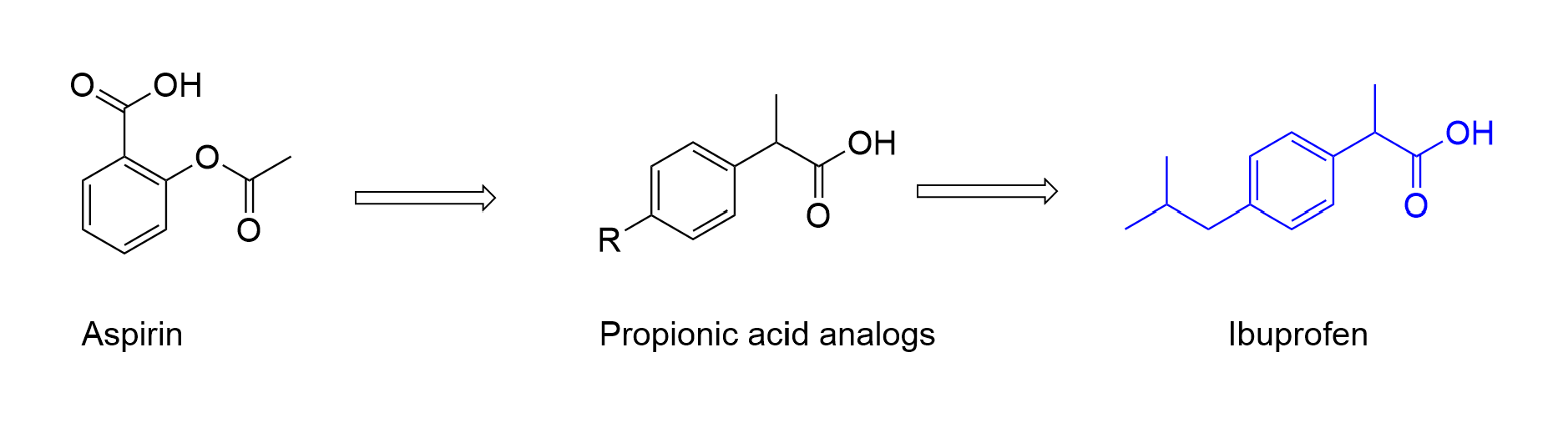
In this Medicinal Chemistry story, I describe the discovery of ibuprofen, one of the world’s most successful anti-inflammatory drugs. What began as a search for a safer alternative to aspirin eventually led to a medicine that has been taken by billions of people and remains a cornerstone of pain management more than half a century later.
The story starts in the 1950s at Boots Pure Drug Company in Nottingham, England. At the time, rheumatoid arthritis was commonly treated with aspirin, often at doses exceeding 3–4 grams per day. While effective, such large doses frequently caused gastric irritation, bleeding, and tinnitus. Boots decided to launch an ambitious research program to find a safer anti-inflammatory agent.
The project was led by Stewart Adams, a young pharmacologist, working closely with medicinal chemist John Nicholson and a multidisciplinary team. Their goal seemed straightforward: discover a compound with aspirin’s anti-inflammatory efficacy but with improved safety and tolerability.
Of course, medicinal chemistry is rarely straightforward.
The team initially explored numerous classes of compounds related to known anti-inflammatory agents. Hundreds of molecules were synthesized and tested, many showing modest activity but little improvement over existing therapies. One promising series emerged from substituted phenylacetic acids.
“These compounds show activity,” Adams reportedly remarked after reviewing the animal data, “but not enough to justify development.”
Nicholson agreed.
“We need something more potent. Something patients can take at lower doses.”
The chemists began systematically modifying the aromatic ring and side chain. Small changes often produced dramatic effects. Moving a substituent from one position to another could completely eliminate activity.
One day, a compound designated BTS 13621 arrived for biological testing. Structurally, it contained a para-isobutyl group attached to a phenyl ring and a propionic acid side chain.
The result surprised everyone.
The compound displayed significantly greater anti-inflammatory activity than many earlier candidates.
“Run it again,” someone suggested.
The experiment was repeated.
The activity remained.
Encouraged, the team explored related analogs. They varied the alkyl substituent, changed chain lengths, introduced additional groups, and examined different substitution patterns around the aromatic ring.
The medicinal chemistry lessons were revealing.
Removing the isobutyl group dramatically reduced potency.
Moving the isobutyl substituent away from the para position weakened activity.
Lengthening the side chain often decreased efficacy.
Adding excessive polarity frequently reduced absorption.
The para-isobutyl arrangement appeared to provide an ideal balance between hydrophobic interactions and molecular size, allowing efficient binding to the biological target—although at that time the cyclooxygenase (COX) enzymes had not yet been discovered.
Among all the compounds examined, one molecule consistently emerged as the best compromise between potency, safety, and pharmacokinetic properties.
That molecule became known as ibuprofen.
Interestingly, the drug was initially developed and marketed as a racemate. The molecule contains a chiral center, producing both R- and S-enantiomers.
Years later, researchers discovered something remarkable.
Only the S-enantiomer possesses significant cyclooxygenase inhibitory activity. However, the body partially converts the inactive R-enantiomer into the active S-form through a metabolic inversion process.
“Nature is doing half of our stereochemistry for us,” one scientist joked after the phenomenon was understood.
This fortunate metabolic pathway allowed the racemic drug to remain highly effective despite containing only 50% of the directly active enantiomer.
Clinical trials during the 1960s demonstrated that ibuprofen provided substantial relief in rheumatoid arthritis patients while exhibiting improved tolerability compared with high-dose aspirin. In 1969, the drug was approved in the United Kingdom as a prescription medicine.
Its greatest success, however, was still ahead.
As experience accumulated, it became clear that ibuprofen possessed an unusually favorable combination of efficacy, safety, and convenience. Lower doses proved effective for common pain conditions such as headache, fever, muscle aches, and dental pain.
In 1983, the United Kingdom approved ibuprofen for over-the-counter use, followed shortly thereafter by the United States.
What began as a medicinal chemistry effort to improve upon aspirin had become one of the most widely used medicines in human history.
Looking back, the structure appears deceptively simple. Medicinal chemists often joke that the best drugs are the ones that look obvious after someone else has discovered them. Yet ibuprofen emerged only after years of systematic structure-activity relationship studies, countless synthesized analogs, and careful optimization.
The final molecule embodies several enduring medicinal chemistry principles: maintain the essential pharmacophore, optimize lipophilicity without excessive complexity, avoid unnecessary functionality, and seek the simplest structure capable of delivering the desired biological effect.
More than sixty years after its discovery, ibuprofen remains a reminder that elegant medicinal chemistry does not always produce complicated molecules. Sometimes the most successful drugs are the ones that achieve precisely the right balance—and nothing more.


